Your phone becomes a pro microphone for your computer. Wireless or USB, encrypted, a few milliseconds of latency. Windows and macOS see a real mic — so every app does. Then it keeps going: voice effects, a soundboard, your game's chat translated, synced multi-phone recording — all from the phone on your desk.
The apps are in preparation, and the two computer companions ship with them. This page is already here so you can read what EZ Microphone does — and, on the privacy page, exactly what it does with your voice.
The phone app, and the free companion for Windows or macOS. Two minutes, tops.
Point the phone at your computer screen. Pairing done — and your computer's identity is pinned for good.
A virtual microphone shows up on the computer. Pick it in Discord, OBS, Zoom, your game. The app then plays your voice back to you and tells you which app is listening — so you know it works before you go live.
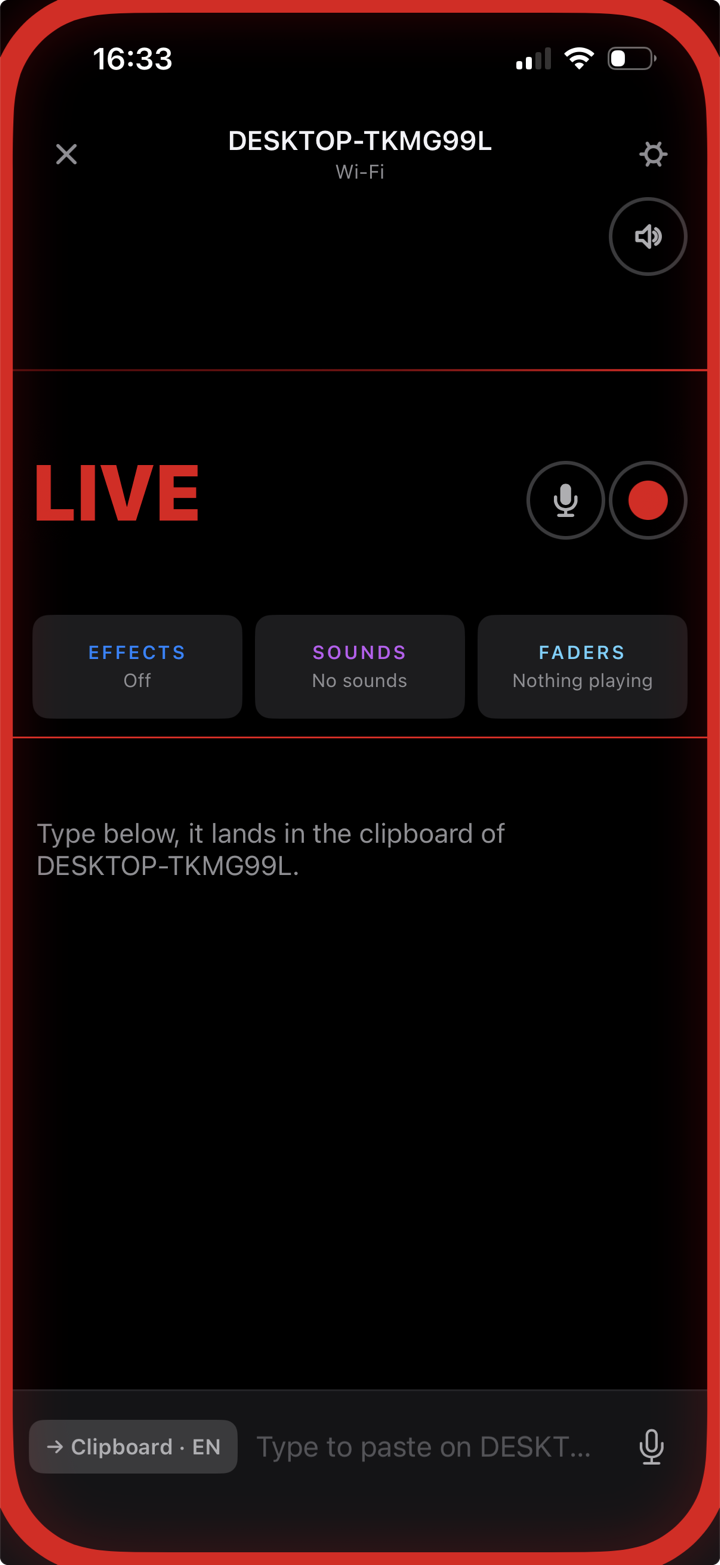
The phone lies flat on the desk while your eyes are on the monitor. So the screen is built to be read from the corner of your eye: the frame changes colour with your state, the wave is your voice — flat means muted, and you see since when. Same screen on iPhone and Android.


Grouped by what you're doing. Every one of these is shipped, in the app today.
What makes it a mic you can trust on air.
Wi-Fi or a cable, and it switches between them mid-session on its own. On Android the app walks you to the one setting the cable needs.
An audio driver on Windows, a Core Audio plug-in on macOS — not a browser trick. Every app sees it. Even games.
Modern cryptography, your computer's key pinned by the QR you scanned. Nothing goes through a cloud, ever.
A neural network strips the fan, the keyboard, the street. Your voice stays. Free, forever.
Eight seconds of your room under the slider: the floor is the flat band, your voice the peaks, the threshold a line between them. Green passes, grey is cut.
Say something — the PC plays it back on its speakers. Then the app names which program is listening to EZ Mic. No more "can you hear me?"
30, 50 or 120 ms of buffer. Tight for a game, generous for a shaky Wi-Fi. The live figure is on screen while you talk.
Echo-cancelled voice for calls, mute synced both ways between phone and computer, a hotkey on the PC — and a buzz on the phone if you talk while muted.
Shaped on the phone itself — so it works even without a computer.
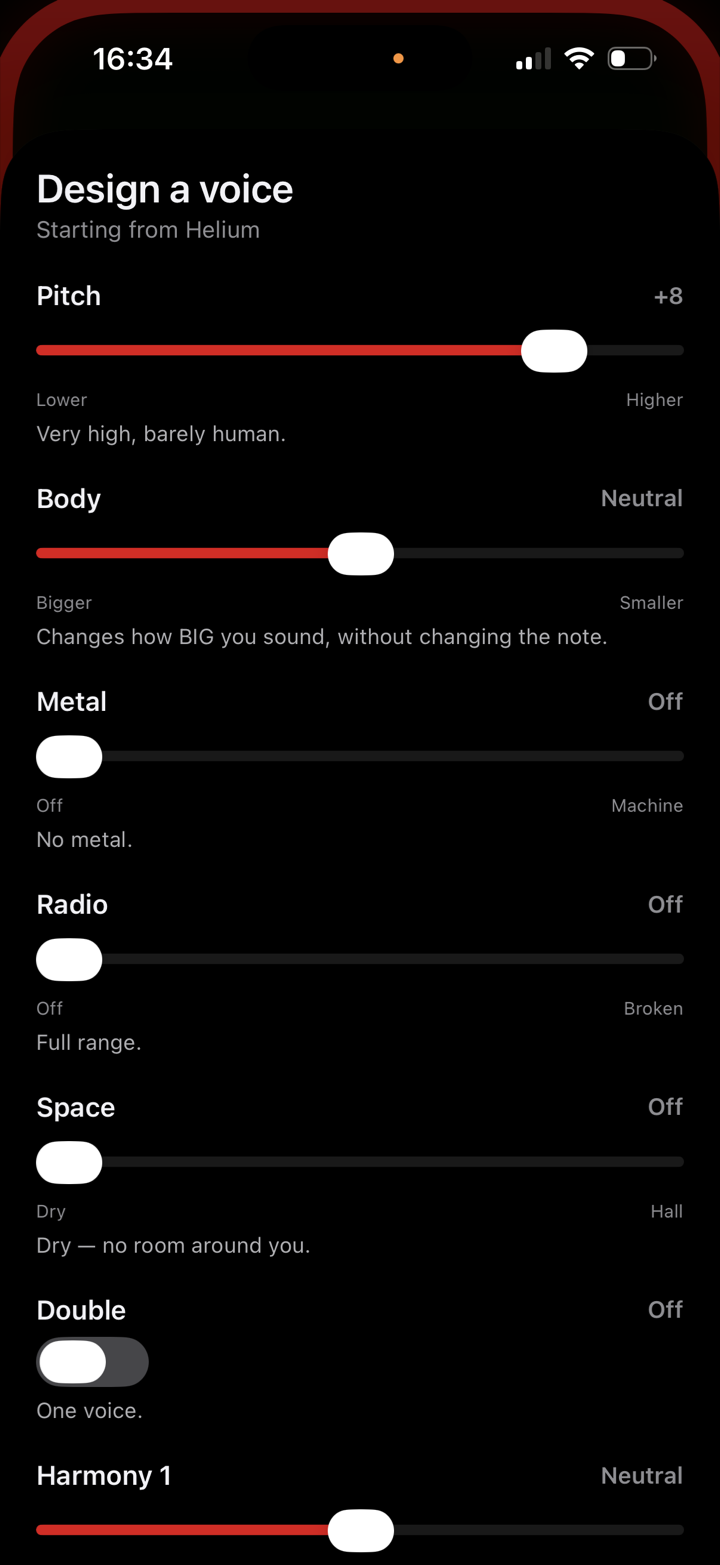
Autotune, hardtune, harmonizer, robot, Dark Vader and 15 more. Processed on the phone, in a few microseconds per block.
Every effect opens into its real controls — pitch, body, space, harmony. Shape it live in your headphones, name it, keep it.
Hear yourself back in the phone's headphones, effects included, over Wi-Fi or the USB cable. Like a booth.
Three-band EQ and a compressor, four ready-made timbres. Free.
Never alt-tab out of the match. The phone is already on the desk.
Up to 99 pads, your own MP3 / WAV / M4A, trimmed with two handles like a voice memo. Fires even while you're muted. Drop files in the PC's library and pick them from the phone.
Your friend just said the line of the night. Tap: the last thirty seconds of the PC's sound become a pad. You never see it coming — that's the point.
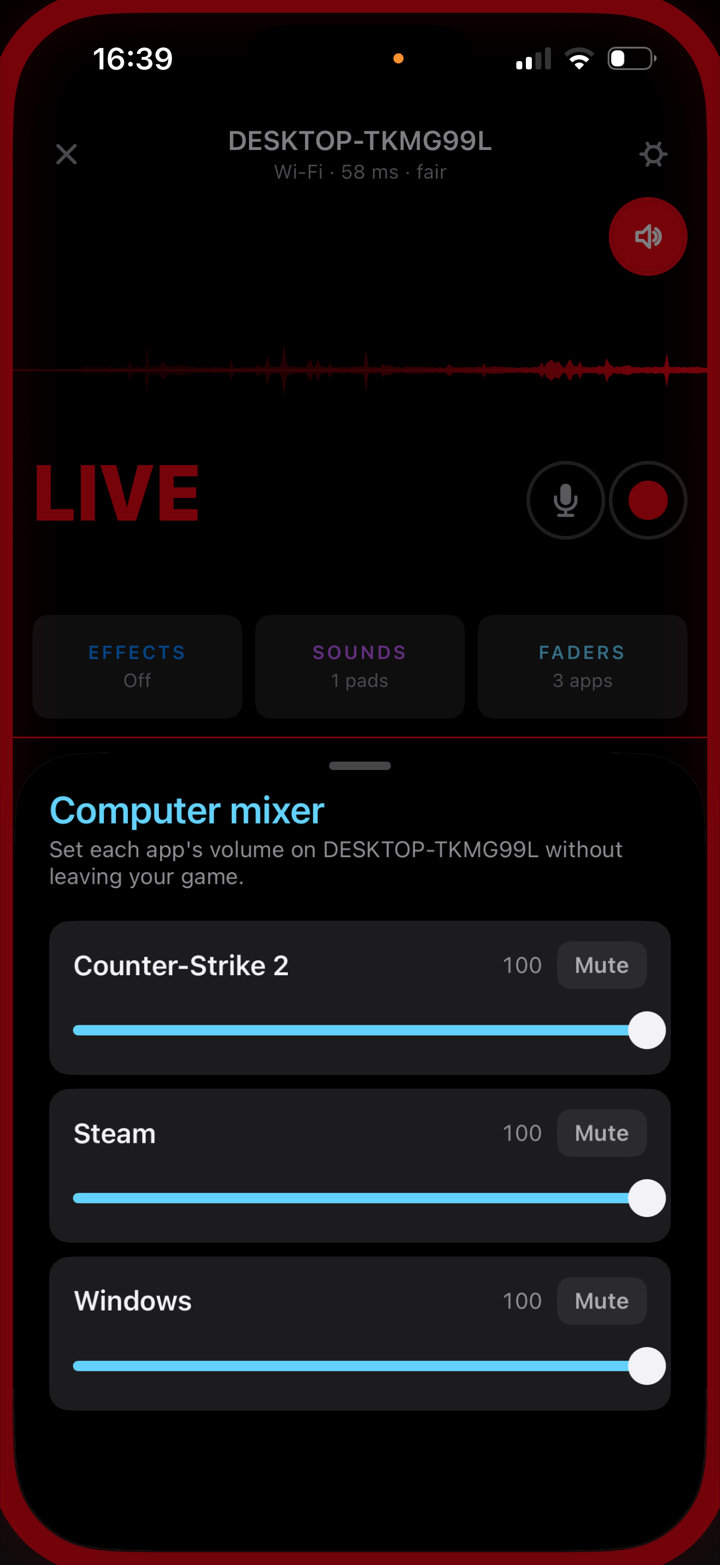
One slider per PC application — Spotify, Discord, the game — on the phone. Music too loud mid-round? Fixed without leaving the match.
Counter-Strike 2 writes its chat to a log. The phone reads it, translates it on device, and shows it under your wave — with the round number. Tap a line to reply in their language.
Out for a smoke, the match starts — the phone in your pocket buzzes. Official game hooks only (CS2, Dota 2, League of Legends). No overlay, no memory reading, nothing that gets you banned.
Grab a drink between rounds and keep hearing the lobby in the phone. Answer "coming" from the kitchen. Works without earphones — echo is cancelled.
Playing on speakers? EZ Mic hears what the PC plays and what the phone picks up, and pulls the game out of your voice channel. Measured: 17 dB of echo gone, your voice untouched.
AirPlay speakers — Apple TV included, paired with the on-screen code — and the PC's own outputs, at the same time as the virtual mic. Fill the room.
Sometimes you can't talk. Sometimes they don't speak your language.
Hold, say the phrase, release — it's ready for Ctrl+V on the computer, translated if you asked. Recognition and translation happen on the phone.
Someone's asleep, or you don't know how to pronounce it. Type it — same destination, same translation, on every phone.
You speak French; a voice says it in English straight into the game's voice chat. Your squad hears a teammate, not a translator.
Copy something on the computer, read it on the phone — translated if it isn't in your language. On request only, never watched.
Several phones, one file, every voice on its own track — and in time.
Mono, stereo, LCR, surround 4.0 — or one track per phone, edited apart afterwards.
Each phone timestamps its capture; the computer places every track at the instant it was recorded, not the instant it arrived. Wi-Fi or cable, no drift.
Before a multi-phone take, the PC plays a click through its speakers and measures each phone against it. If something's off, the phone that pressed REC decides: align, record as is, or cancel.
Two phones or more, and REC opens a sheet on the one that pressed it: who's in the take, and on which channel. Left / Right for two, named tracks beyond.
At STOP, the master is offered the file: keep it on the computer, or pull a copy to the phone — Files on iPhone, Music on Android.
A 48 kHz WAV in Documents › EZMic Recordings on the computer, one file per take, dropouts kept as silence rather than drift. Opens in any editor.
What the Mac's own engines make possible.
On-device speech recognition writes what you say as you say it — corrected word by word, settled sentence by sentence. Pick the accuracy tier you want.
Your captions, translated live and spoken into the virtual mic in the other language, your own voice ducked underneath. An interpreter, one sentence behind.
A menu-bar app that turns a Mac into a source for the PC — same encryption, same Opus, same everything.
Every effect opens into its own controls — only the ones that matter for that sound. Slide, and you hear it change live in your headphones. When it's yours, name it and keep it.
A game's chat is an image on screen — you can't select it, let alone translate it. EZ Mic reads the log the game writes for itself, and the phone translates it on device, name untouched. Tap a line and answer in the other person's language — typed, or straight into the game's voice chat.
Flip one switch on the phone and the Mac writes what it hears — corrected word by word, settled sentence by sentence. Recognition runs entirely on the computer: no cloud, no account, nothing leaves the room. Add a target language and Babel speaks the translation into the mic.
Fast enough that your own voice in the monitor doesn't feel like an echo. The app shows the live figure while you talk — no guessing, no faith required.
Soundboard, voice effects and the clip of the night, one thumb away on the phone in your hand. Never touch the PC.
Mic, faders and the chat translated without alt-tabbing out of the match. Your squad hears you, not your keyboard.
One phone per guest, one track per voice, aligned within two milliseconds. Edit them apart afterwards.
Meeting mode, mute synced both ways between computer and phone, and a hotkey when you need it now.
No tiers, no crippled version. You get the whole thing on day one; when the trial ends it stops and says so. Two ways to keep it, both through your store — nothing to enter, nothing to remember.
It's in your pocket. It's already good. Plug it in.
Nothing to download yet: the apps and the two companions arrive together. Write to contact@ezmicrophone.com if you want to hear about it.
Windows: 64-bit x64 only — the virtual audio driver does not exist for Windows on ARM. macOS: Apple Silicon (M1 and later), not Intel.